The Child Care Squeeze
Here is something you can do at your own kitchen table tonight. It takes about ten minutes and a bank statement.
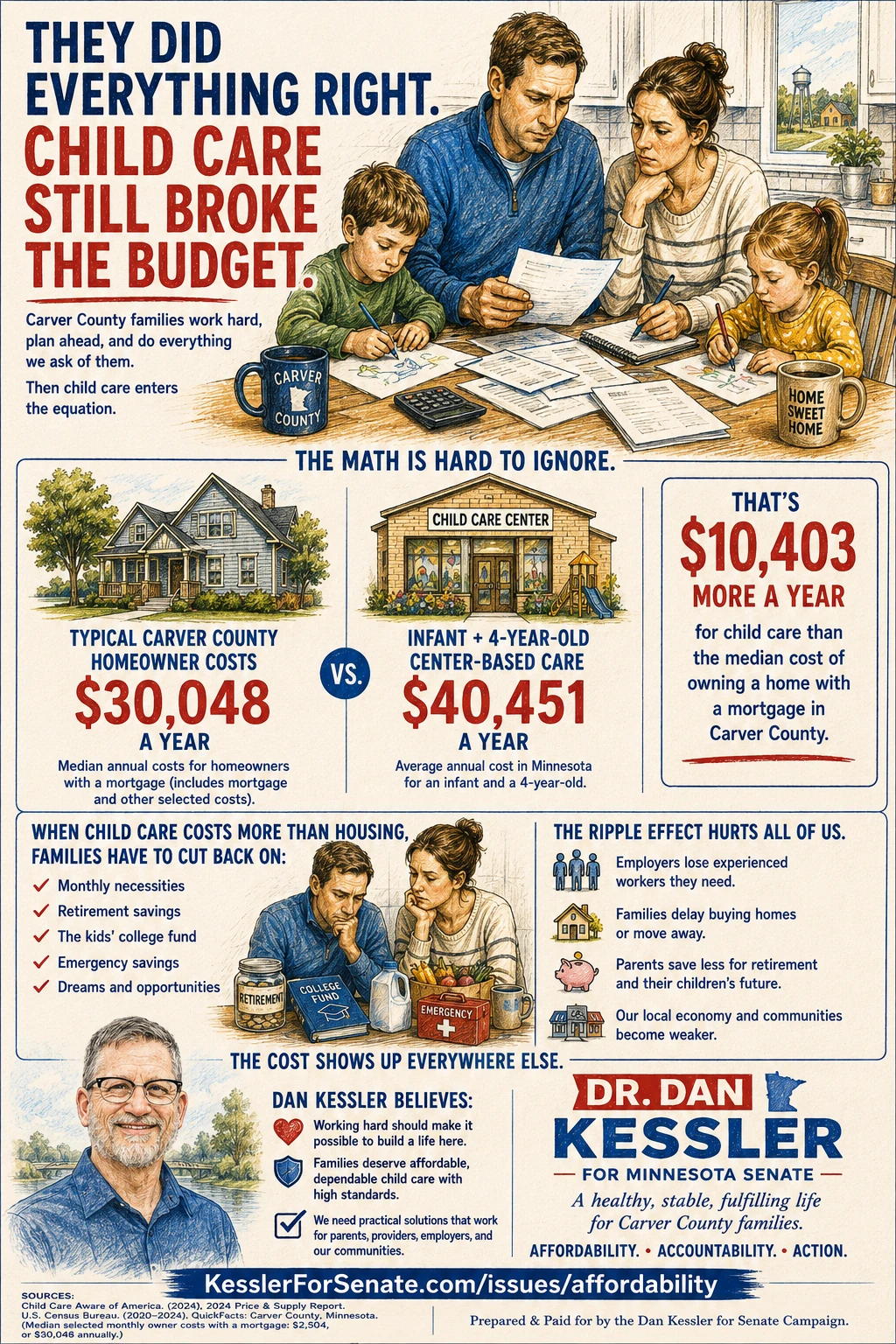
Add up what your house actually costs you in a month. Not just the mortgage payment. All of it: principal, interest, property taxes, homeowner's insurance, the utilities. In Carver County, the middle of that range is $2,504 a month. Over a year, that's $30,048.
Now add up child care for an infant and a four-year-old at a center. The Minnesota average is $40,451 a year.
So the kids cost $10,403 more than the house.
I've walked through that arithmetic with people who assumed, right up until they saw it written down, that they had done something wrong somewhere. They hadn't. They bought a sensible house. They took a good job. They put a little away when they could. Then a second kid showed up, and the math stopped working.
Nobody is gouging you
I want to be fair here, because it would be easy to be lazy about it.
The centers in Chaska and Waconia and Victoria are not getting rich. Infant care costs what it costs for a reason. One adult can't safely watch eight babies, so the staffing ratios are set in law, and those ratios are exactly why you're willing to hand a four-month-old to somebody at seven in the morning and go to work. I'm totally fine with the ratios. What I have a problem with is that we've built a system where the cost can only land in two places: on parents, who can't pay any more, or on the people doing the work, who aren't getting much of it. The last time somebody laid the wage numbers out for a House committee, a lead teacher at a Minnesota child care center was making somewhere between seventeen and twenty dollars an hour. An aide was making less.
So programs close. Minnesota has lost more than 4,000 family child care businesses since 2014. And when a home program closes in a town like Mayer, families don't shop around. There's nothing to shop.
What a number that big actually does
Here's the part that doesn't show up in the statistics.
Nobody defaults over child care. You adjust. You just quietly stop doing the things that were supposed to be the whole point.
The retirement contribution goes from eight percent to four, then to nothing. The college fund gets opened and never really gets funded. The emergency savings turn into the child care account. You were going to fix the driveway this year. You'll fix it next year.
And then it shows up at work. One parent runs the numbers, sees that the second income barely clears the cost of care, and steps out of the workforce for four or five years. Some employer in Chanhassen just lost a trained, experienced person, and it wasn't over pay or management or anything they could have fixed.
Then it shows up in the housing market, which is where this started. Young families look at that number and decide they'll rent a while longer, or they look at Carver County and decide on somewhere cheaper. That's how a county spends thirty years attracting young families and then slowly stops getting them.
What I think we do about it
I'm not going to pretend I've got a tidy fix, because anybody who says they do is selling something.
But I think three things are true, and I'd say them at any door in this district.
Working hard should make it possible to build a life here. Not a comfortable life necessarily, not a fancy one, but a stable one, in the town where you work.
Families deserve care that's affordable and dependable, and they shouldn't have to trade away safety standards to get there. The answer to expensive infant care is not more babies per adult.
And the fix has to work for everybody at the table at once: parents, providers, the people who actually do the work, and the employers who lose good workers over it. A policy that helps parents by squeezing providers isn't a policy. It's a transfer.
Do the arithmetic
I don't know that this gets fixed in one session. Child care has been broken for a long time, under Republicans and under Democrats, in states a lot richer than this one.
But $10,403 isn't a mystery. It's a number. Numbers can be changed, and changing numbers like that one is most of what a legislature is actually for.
Go do the math at your own table. If it comes out the way it's coming out for your neighbors, I'd like to hear about it.